RV Tech & Tips
In the RV Power & Off-Grid Systems hub.
How Much Solar Do I Need to Work From My RV?
Some links below are affiliate or referral links, if you buy through one I may earn a small commission at no extra cost to you. I only recommend gear I actually use, see my full kit on the My RV Setup page. Full disclosure.
If you're running a laptop, a monitor and Starlink out of an RV, your real desk load lands around 1,000 to 1,500 watt-hours a day. Plan on 300 to 400 watts of solar panel and at least 1,000 to 2,000 watt-hours of battery to cover it. A flat roof array will get you through that day easily in June and come nowhere close in December.
Here's my honest frame on this. I run a 23-foot Thor Compass AWD with only 100 watts of solar on the roof. That panel is a maintainer, not an office. My batteries run the desk, and my generator is the real refill. I won't sell you a bigger panel than you need. Here's the math.
How I put this together
I spent 30 years in enterprise IT, so I size power like a server room: know the load, size the supply, keep headroom. The numbers below come from three places. My own gear and readings, including a real EcoFlow display photo from a workday and the field run I got out of my old EcoFlow Delta. Starlink's official spec sheets for how much the dish actually draws. And NASA's POWER climatology data for how much sun different places actually get, month by month. The math connecting those three is mine, and I show it as I go.
Your load, not the panel
Size the battery and the panel to your desk, not the other way around. Here's what a mobile office actually pulls, from Starlink's spec sheets and typical device draws.
| Device | Typical draw |
|---|---|
| Laptop | 45 to 65 W while working |
| External monitor | 20 to 30 W |
| Router and networking | about 10 W |
| Phone and odds and ends | 10 to 20 W |
| Starlink Mini | 25 to 40 W |
| Starlink Standard, older model | 50 to 75 W |
| Starlink Standard, current model | 75 to 100 W |
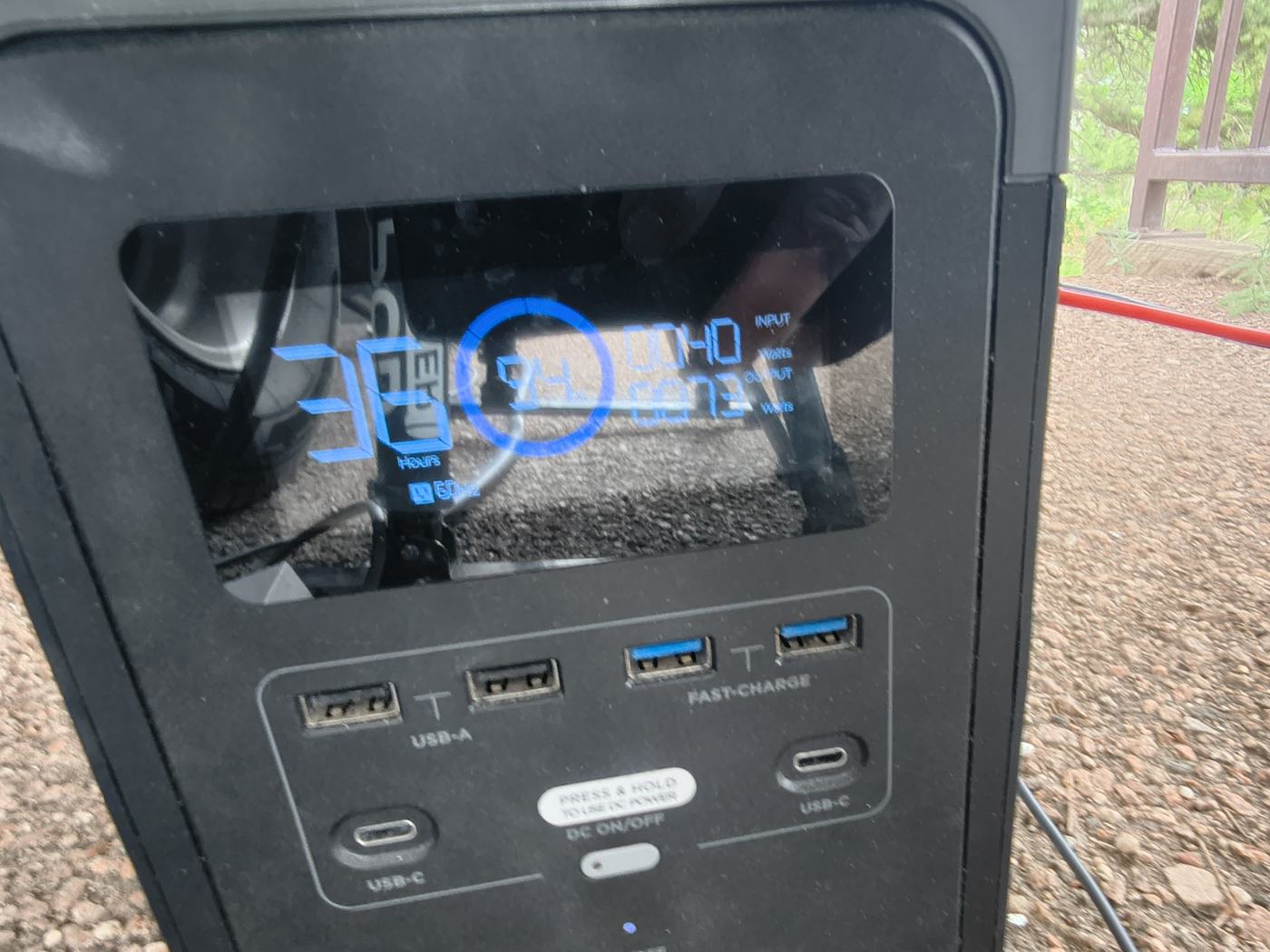
That 73 watts is one snapshot, not an all-day average, but it's useful arithmetic. Run 73 watts across a full eight-hour shift and you get roughly 580 watt-hours. Add a current Standard dish running longer than your work hours, two screens, and some evening use, and most real days land in that 1,000 to 1,500 Wh range I opened with. For the full breakdown on what the dish itself draws, I've got a page on Starlink power consumption.
The formula and the real sun by month
Once you know your watt-hours, the panel math is one line: panel watts x peak sun hours x 0.75. The 0.75 covers wiring loss, heat, and what your charge controller and battery actually keep. Peak sun hours is NASA's POWER climatology data for how much usable sun a place gets on an average day that month. I ran a 400W array through five spots on that data to show how much the number swings.
| Place | Dec, 400W flat roof | Dec, 400W tilted steep | June, 400W flat | Dec sun hours, flat / tilted |
|---|---|---|---|---|
| Orlando, FL | ~960 Wh | ~1,400 Wh | ~1,670 Wh | 3.2 / 4.7 |
| Quartzsite, AZ | ~950 Wh | ~1,620 Wh | ~2,570 Wh | 3.2 / 5.4 |
| Albuquerque, NM | ~870 Wh | ~1,560 Wh | ~2,460 Wh | 2.9 / 5.2 |
| Colorado Springs, CO | ~750 Wh | ~1,420 Wh | ~2,240 Wh | 2.5 / 4.7 |
| Olympia, WA | ~260 Wh | ~530 Wh | ~1,740 Wh | 0.9 / 1.8 |
That's our math from NASA POWER averages, not a manufacturer's claim. A few things jump out. A 1,200 Wh office day is covered by 400 watts flat on the roof in June at every one of those spots, and in December it isn't covered at any of them. Tilting a portable panel steeply at the winter sun helps a lot, anywhere from about 45 percent more in Orlando to roughly double in Olympia, but even tilted, Olympia in December only gets you to about 530 Wh. If you winter in the Pacific Northwest, solar alone is not your plan. Plug your own coordinates into PVWatts before you buy anything. It'll give you the real number for your exact spot, not an averaged guess from a table like mine.
The battery is the office
Here's the part solar sellers skip. Size your battery for a full day plus one cloudy day, because the sun will not cooperate on schedule. My old EcoFlow Delta, about 1,200 Wh, gave me something like 4.5 to 5 hours of runtime with laptops and Starlink running. That's why I say 1,000 Wh is a floor, not a goal. It's an afternoon, not a full day of real work. That unit also overheated more than once when it was charging and powering gear at the same time, so I don't lean on pass-through charging in a hot rig anymore. My real bank now is two Battle Born batteries plus a Pecron F3000, something like 5,600 Wh total, and that gets me about two and a half to three days of real work before I need to refill. The whole setup, battery by battery, is in my off-grid RV power page.
If you're starting from zero and want one box that handles storage and solar input together, EcoFlow's current DELTA 3 is a reasonable place to start: 1,024 Wh of lithium, up to 500 watts of solar input, and under 10 millisecond UPS switchover so your dish doesn't blink when the power source changes. That's a starting point, not a full-timer's only battery.
Roof panels versus portable, and why the controller matters
Roof panels collect whenever the sun is out, and you never have to set them up. The tradeoff is they lie flat and they get hot, and the table above shows what a flat panel costs you every winter. Portable folding panels cost you the setup time, but you can tilt them steep at low winter sun, which is where most of that table's December gain comes from. Whichever you run, use a real MPPT charge controller, not the cheap PWM kind. MPPT squeezes more out of the same panel, especially on hazy or cold mornings.
I only run 100 watts on my own roof, and I lean on the generator for the heavy lifting, not a bigger array. If you want solar to actually refill your bank instead of just slowing the drain, a 200W folding panel or two, tilted at the sun, is what I'd add.
What solar won't do
It won't run your rooftop air conditioner. An A/C compressor pulls a steady, heavy load that no RV solar array is built to match. Off batteries alone, figure maybe 3 to 4 hours of A/C before you're hunting for shore power or a generator. My Pecron ran our RV's A/C about 2 hours in June 2026. My generator shuts off on its own once the tank hits about 25 percent, so the engine always has fuel left to drive on. You never get the whole tank for power. I've got the full fuel numbers in Generator Math, and the surge problem itself in why your A/C can kill your Starlink connection.
One more thing worth doing regardless of panel size: run your dish off a battery buffer, not straight off the panels. The station sits between everything and the dish, so power swings and surges hit the battery, not the dish. A Starlink reboot takes about 10 minutes to reacquire, and 10 minutes is a dropped meeting. I've got more on sizing that buffer in does Starlink need a UPS, and what that setup looks like day to day in running Starlink off the Pecron F3000. And when the dish does drop, here's what keeps us online.
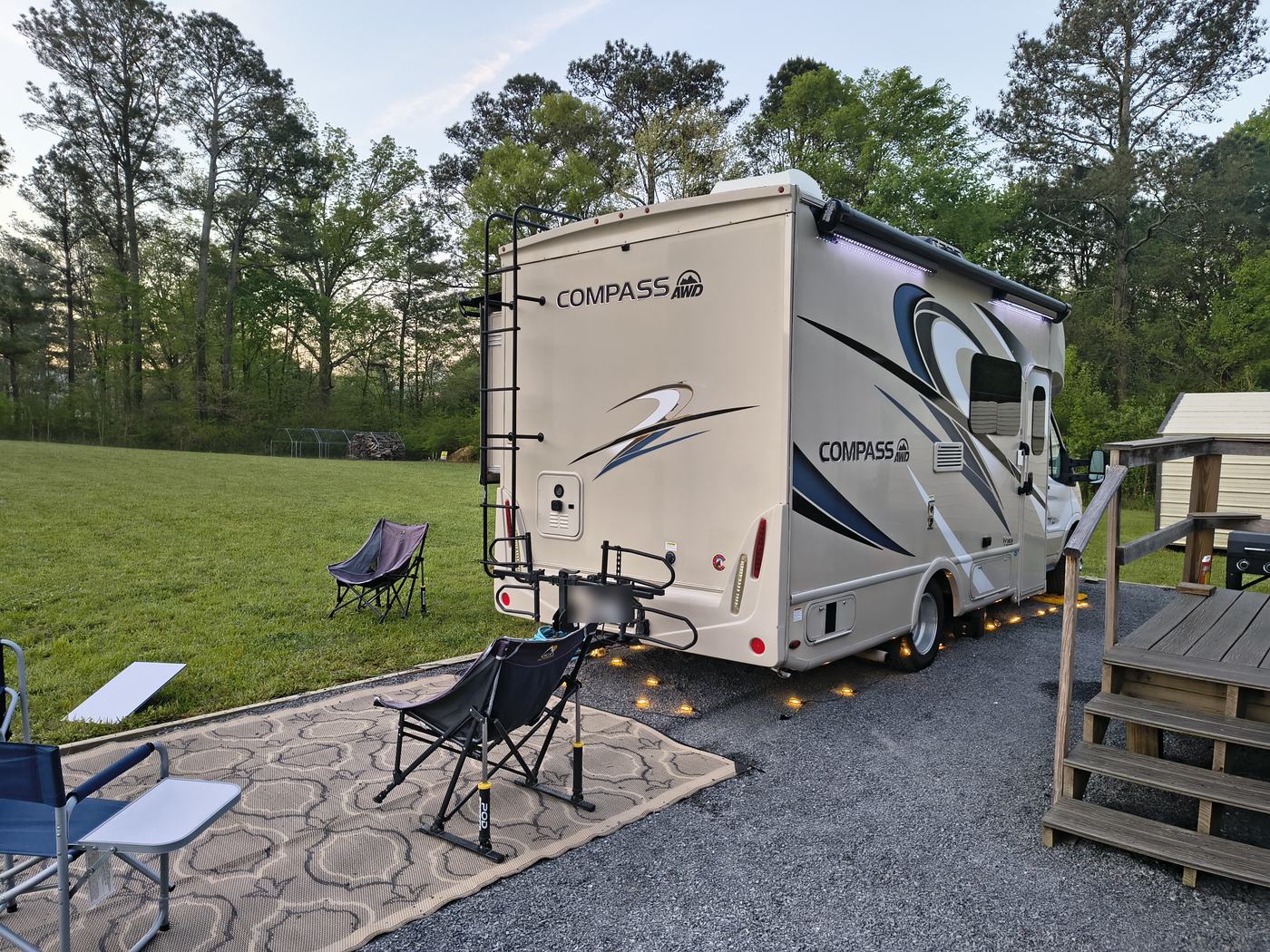
Here's what that looks like in our rig: the Pecron in the bay running Starlink, 100 to 200 Mbps at that spot.
Video: Pecron F3000 running Starlink on our Compass AWD (my phone video).
My pick, by how you work
- Weekend or part-time worker: a day or two at a time, light use. A 200W panel and a 1,000 Wh power station covers a sunny day with margin, using the math above.
- One full-timer: size for the 1,000 to 1,500 Wh day. That's 300 to 400 watts of panel and 1,500 to 2,000 Wh of battery, more if you winter somewhere cloudy.
- Two people working: double the load, so plan on 2,000 to 3,000 Wh a day. That pushes you toward 600 to 800 watts of panel and a battery bank in the 3,000 to 4,000 Wh range, or a generator you're comfortable running regularly.
Whatever you land on, test it on a real cloudy day before you trust it.
If any of this fits your rig: Starlink, through my referral link, gets us each a free month, it's not a paid commission. EcoFlow's referral program works the same way. As an Amazon Associate I earn from qualifying purchases. The Starlink and EcoFlow links are referral links.
If you want more of this kind of field math, I write about it most weeks on my Substack.
I'm Dominic. See you down the road.